
Electropolishing
Precision Electropolishing for Stainless Steel Components
Improve surface finish, corrosion resistance and cleanability with controlled electropolishing.
Expert Electropolishing provides precision electropolishing for 300-series stainless steel and selected corrosion-resistant alloys. From high-volume small components to large fabricated assemblies, we deliver consistent results from our Gastonia, North Carolina facility.
Experience Matters
What Is Electropolishing?
Electropolishing is an electrochemical metal-finishing process that removes a very small, controlled amount of material from a component’s surface.
The process preferentially reduces microscopic high points while removing embedded contaminants and surface imperfections. This leaves the metal smoother, cleaner and more uniform.
Electropolishing can:
- Smooth microscopic peaks and surface irregularities
- Remove light burrs from edges and detailed features
- Improve corrosion resistance
- Reduce areas where contaminants can collect
- Make stainless steel easier to clean
- Produce a brighter, more consistent appearance
- Improve the service life of qualifying components
Electropolishing is not a coating. It removes surface material instead of applying another layer. The finished surface remains part of the original metal.
How the Electropolishing Process Works
The component is submerged in a controlled electrolyte bath and connected to a direct-current (DC) power source.
During processing, the part functions as the anode. The electrochemical reaction dissolves a microscopic amount of metal from its surface. Raised areas are removed faster than lower areas, reducing surface roughness and creating a more uniform profile.
The process generally includes:
- Part preparation
Components are inspected, cleaned and properly fixtured. - Controlled electropolishing
The parts enter an electrolyte bath where current, temperature and processing time are controlled. - Rinsing and neutralization
Process residue is removed through a managed cleaning and rinsing sequence. - Final inspection
Finished parts are checked against the project requirements and applicable specifications.
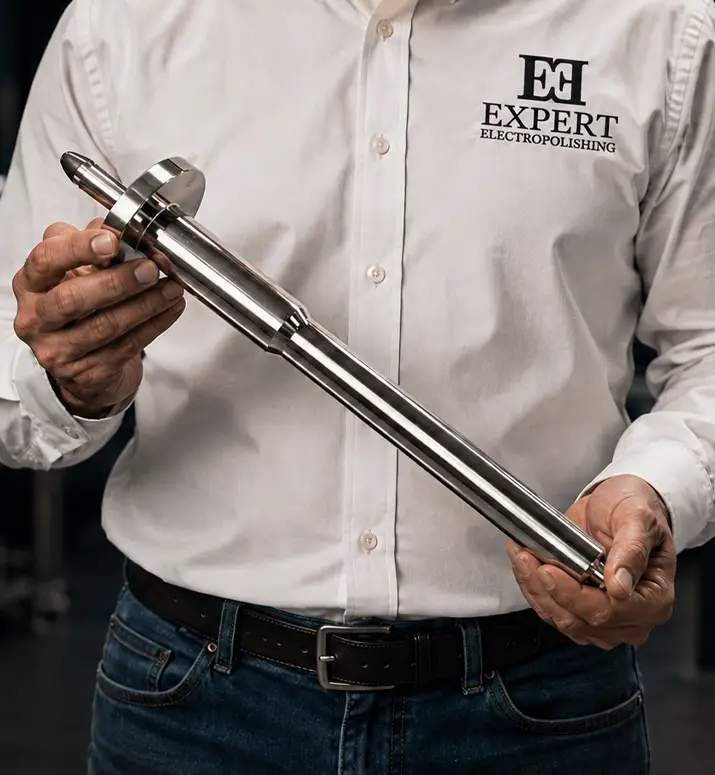
Benefits of Electropolishing
Improved Corrosion Resistance
Electropolishing removes free iron, embedded contaminants and damaged surface material. It also supports the formation of a clean, chromium-rich passive surface on stainless steel.
The result is stronger resistance to rust and corrosion when the base alloy is suited to the operating environment.
Smoother Surface Finish
The process selectively reduces microscopic high points rather than mechanically grinding the entire surface. This lowers surface roughness and creates a smoother, more consistent finish.
Micro-Deburring
Electropolishing can remove small burrs and sharp microscopic projections left by machining, stamping, grinding or fabrication.
It works well for detailed components that may be difficult to finish with mechanical tools. It is not intended to remove heavy burrs or correct major dimensional defects.
Easier Cleaning
A smoother surface offers fewer microscopic areas where dirt, product residue and contaminants can collect.
This benefit makes electropolishing useful for food-processing, pharmaceutical, medical and other applications with strict cleaning demands.
Electropolishing Applications
We process stainless steel parts for a range of commercial and industrial uses, including:
- Machined components
- Fabricated assemblies
- Tanks and vessels
- Tubing and fittings
- Valves and manifolds
- Fasteners and springs
- Wire forms and screens
- Food-processing equipment
- Pharmaceutical equipment
- Marine components
- Automotive components
- Aerospace components
- Decorative stainless steel products
Industries We Serve
Food and Beverage
Smoother stainless steel surfaces can be easier to clean and less likely to retain product residue.
Pharmaceutical and Life Sciences
Electropolishing supports clean, uniform surfaces for processing equipment, tanks, tubing and related components.
Aerospace
Precision components can benefit from micro-deburring, surface refinement and improved corrosion resistance.
Marine
Electropolishing helps stainless steel components withstand exposure to moisture and corrosive operating conditions.
Automotive and Transportation
The process can improve the appearance and surface performance of fabricated, machined and formed stainless steel parts.
Industrial Manufacturing
We process individual components, production runs and fabricated assemblies used across demanding manufacturing applications.